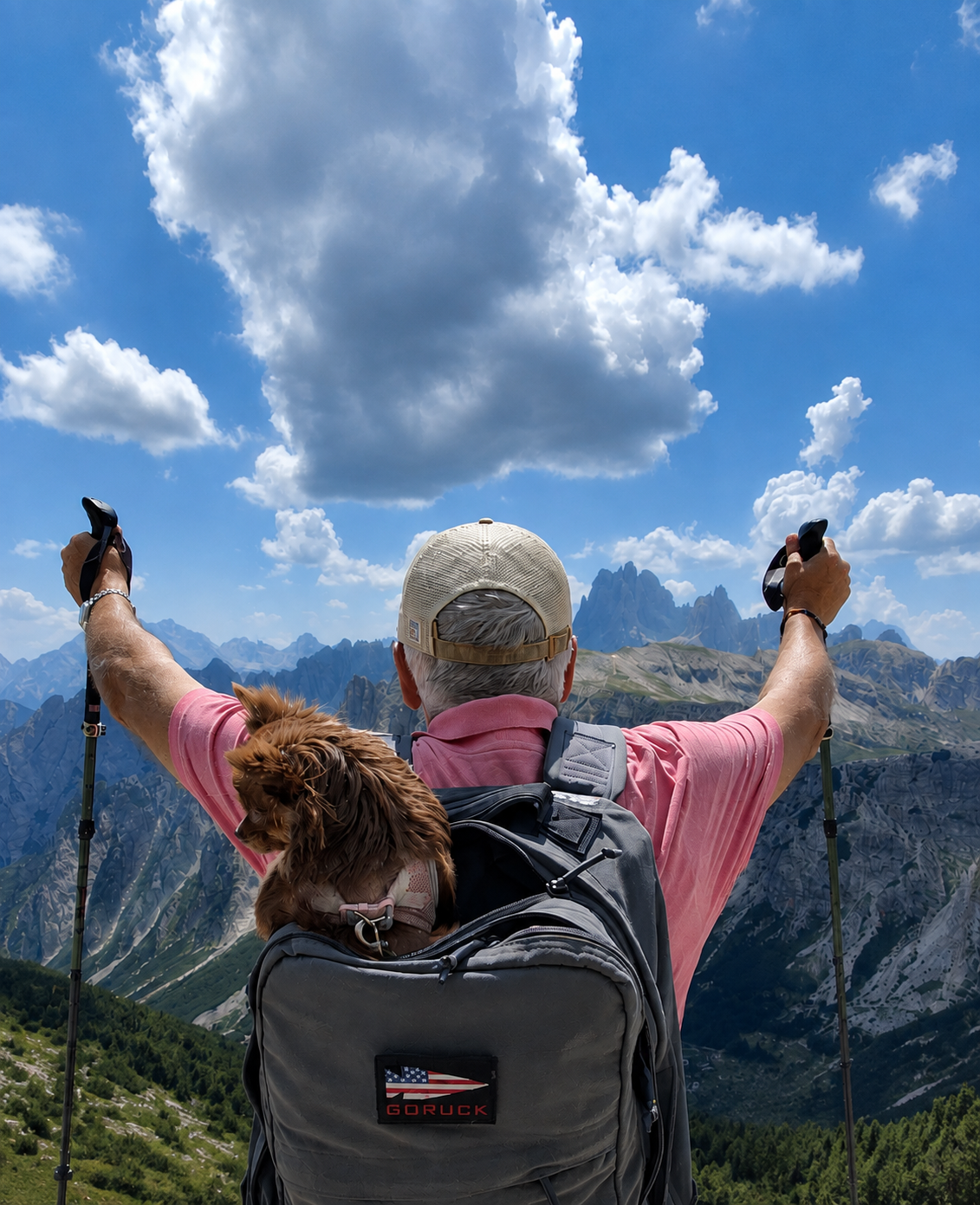
The Dolomites: reaching the Summit Was Never the Point
BE PRESENT, MAKE MEMORIES, DISCOVER WHAT MATTERS
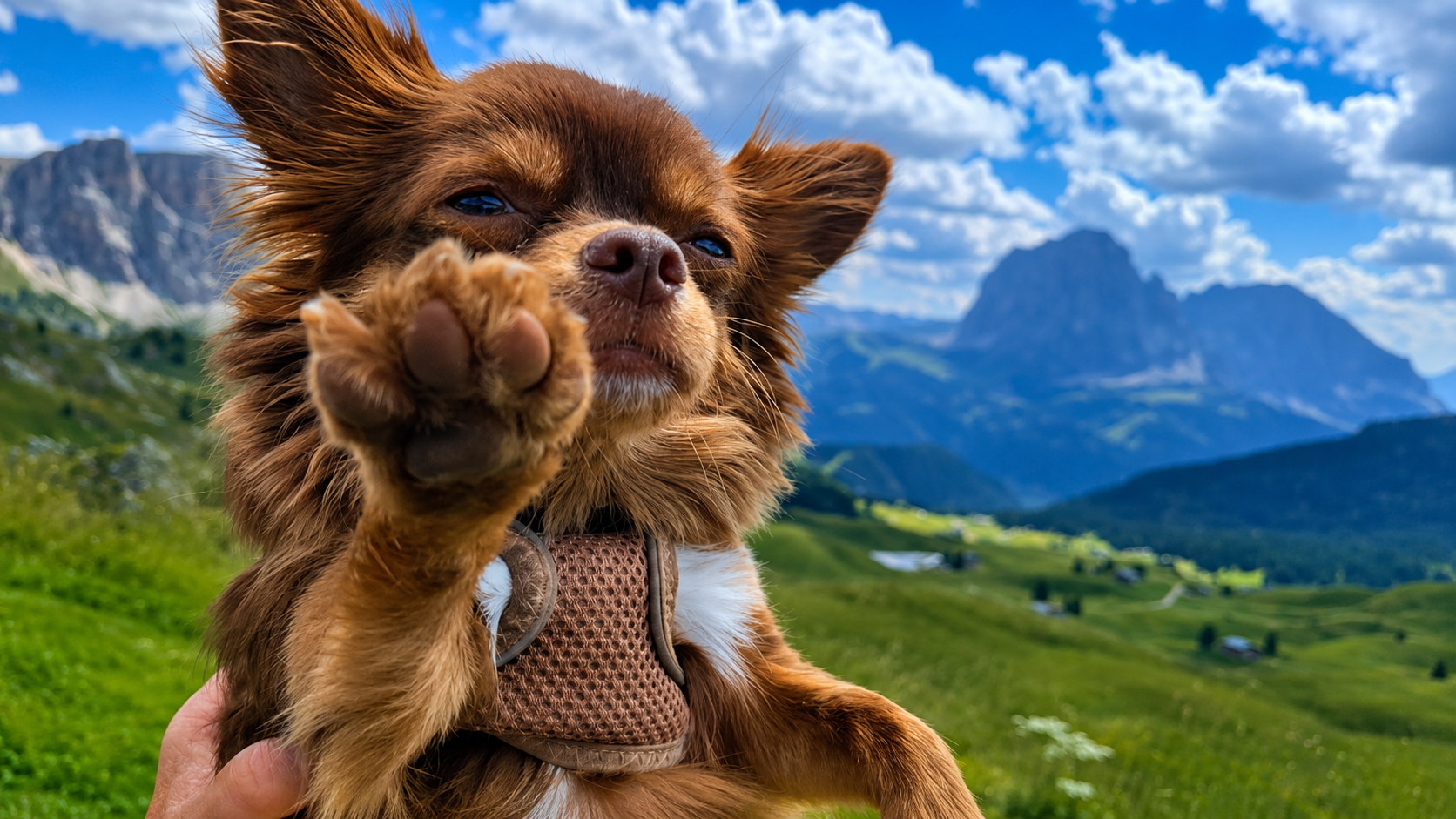
The practicality of taking a seven-month-old, five-pound Chihuahua named Osa across the ocean to hike the Dolomites for eight days was never seriously contemplated.
But the purpose was.
Less about the places we visited. More about what it took to get there.
Less about capturing the subject. More about absorbing the entire panorama.
Less vacation. More self-exploration.
And a conscious effort to uncover what might be hiding in plain sight.
We weren’t going to optimize this trip for photographs, likes, or comments. We weren’t filming the next YouTube sensation: Osa: Diminutive Dog of the Dolomites.
We were going to see extraordinary scenery and attempt extraordinary things. More importantly, we were going to pay attention—experience each moment fully, recognize memories as they were forming, and reflect on what they might teach us.
Be present. Make memories. Discover what matters.
That was the purpose.
Then the trip began.
Could Getting to the Trailhead Be Tougher Than the Trails?
I knew this trip could be brutally hard.
And I’m not talking about putting a puppy on an eight-hour overseas flight and getting her through customs. That was easy.
All I needed to say to her was, “Good dogs get to do fun things.”
The ‘fun things,’ our Dolomite adventure, would involve eight days. Four hikes. Three hotels. Six trains. Seven long-haul buses. Then the local buses and lifts required to reach the trails. All during high season, with major rail lines closed for maintenance.
Screw it. I was 63 and acutely aware that the window for doing something like this wasn’t getting any bigger. I desperately wanted to do it now.
When impulsivity meets urgency, problems are sure to arise. But not to worry, I had help from my buddies, AI and Booking.com. We iterated seemingly thousands of times.
What I didn’t fully appreciate was that their technology—their “intelligence”—was drawing from vast amounts of data about other people’s trips, not necessarily the trip I wanted, and generally assuming things would go according to plan.
Our first leg into the Dolomites began in Munich, Germany, connected through Innsbruck, Austria, and ended in Ortisei, Italy—the heartbeat of the range’s western side. Getting there took eight hours of living hell. Trains weren’t running. Connections didn’t connect. Instructions were unclear. And when the system failed, nobody was willing to paper over the cracks.
Exhausted and discouraged, we met an angel. In Hotel Hell, of all places.
Vanessa.
At first blush, she appeared to be simply working the front desk. It turned out she offered much more.
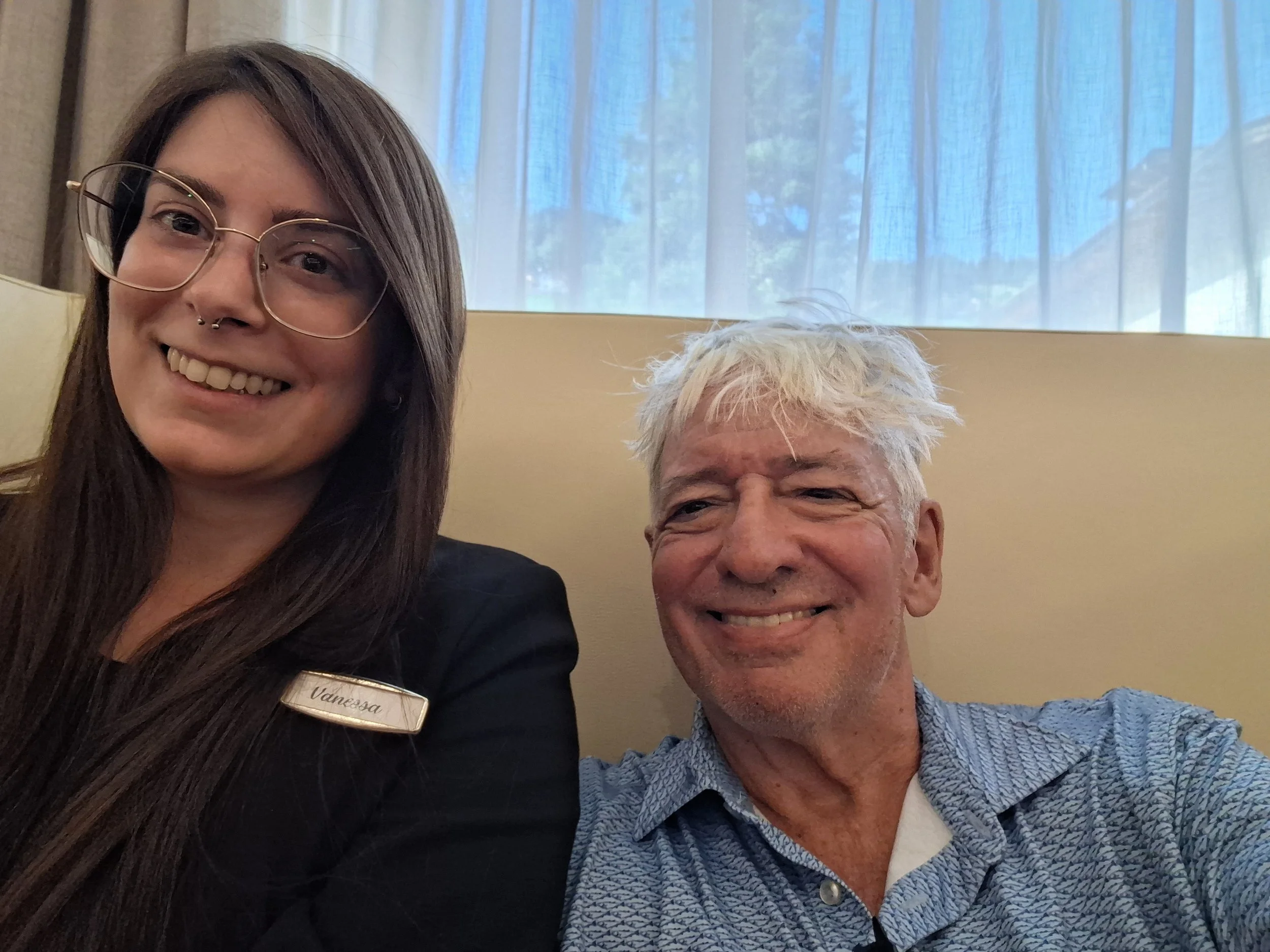
Vanessa took one look at Osa and scooped her up.
“Carina canina.” What a cute dog in Italian.
Osa had experienced a lot of “firsts” that day and couldn’t help but see and smell my stress. Finally, the normally skittish dog felt relaxed. Reassured.
The bond between the three of us began immediately. Everybody felt comfortable, and I told Vanessa—in gripping detail—about our travel nightmare.
Amazed, Vanessa said, “Tom, it took you eight hours to get from Munich to the Dolomites?”
“Well, technology told me it would only take five.”
She paused, rolled her eyes, and said, “I think I know what happened.”
Then, empathetically, she gave me a wider perspective. Regaled me with her own encounters with the Italian public transport system. Missed trains. Failed connections. Stories that made mine pale by comparison.
She explained why these things happened, what to watch for, and how—not to prevent them, but to minimize the frustration.
Ecco! There it is. The missing piece of my plan: local knowledge.
Why did Vanessa step up when so many others had ignored our plight?
My anguish? Maybe.
Osa’s puppy-dog eyes? Certainly helped.
Sharing not just memories but the emotions of similar experiences? Bingo!
Who’s in Control?
Vanessa blessed us with local knowledge. But knowledge doesn’t mean you have control. Even armed with the best advice, there was no guarantee we could execute it.
That had become my central frustration: control kept changing hands.
Planning the trip? My control.
Getting to the trailhead? Out of my control.
But once we stepped onto the trail—yeah, I was back in control.
One step off the gondola, I realized Seceda was a helluva lot bigger—and infinitely more majestic—than anything a 65-inch television or YouTube video could contain.
At first, the trails weren’t too tough. Five-pound Osa loved the rocks beneath her paws. To her, this was heaven.
About a kilometer into the hike, we encountered six Australian women who looked beyond exhausted. Osa gave them the perfect excuse to stop.
“Buggered, mate. Need a bloody break. Pet the dog?”
That’s why I pay Osa the big bucks. Conversation starter, intelligence gatherer.
“So, how are the trails?”
One of them pointed far below us.
“See all the way down there? We’re staying at Col Raiser.”
I looked down to what seemed to be the bottom of the vast landscape.
“Crikey, that’s a long bloody way!”
They had climbed about halfway to the epic ridgeline. To execute their mission, the trek would total roughly 1,500 vertical feet—the equivalent of about 125 flights of stairs, except considerably nastier. Steep grade. Constant ascent. Loose rock. Tricky footing. Unrelenting.
Then she pointed seemingly forever upward to the mountain crest that looked like the end of the world …
“But see the famous Seceda ridgeline? That’s what we came halfway around the world for. Good on ya, mate—onwards and upwards! That’s a bloody cute pup ya got there.”
As they continued their trek, I looked up, then down …
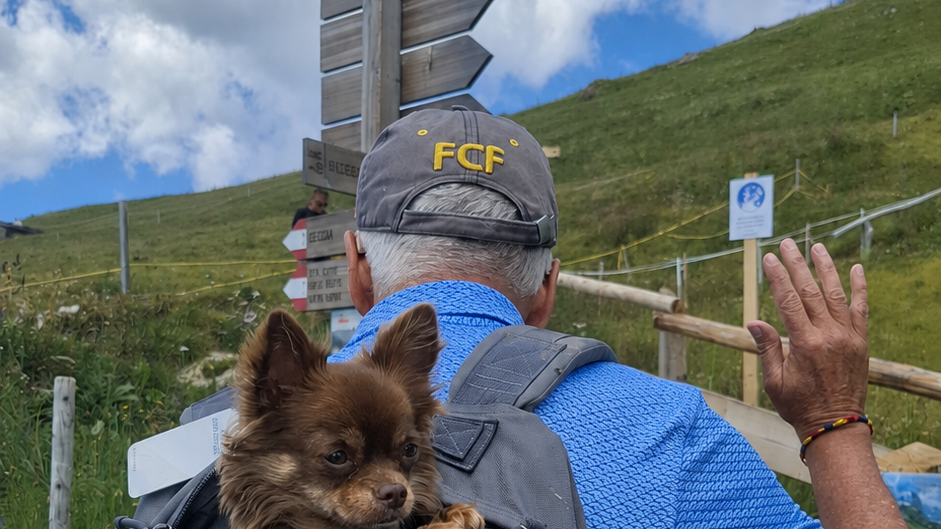
In shock, “What the fuck? I missed the trail to the ridgeline.”
The consequences were immediate. Do I retrace my steps? Keep going? What the hell do I do now?
One wrong turn had moved me from feeling completely “in control” to realizing that this monster of a mountain was in control—and that it had really been IN CONTROL all along.
Now, given my state of exhaustion and the time of day, the only viable route led down to where the Aussies had started.
“Well, looks like we take our medicine today Osa. Good news we had some pad in the plans. We’ll just come back tomorrow for the ridgeline. At least we know how to get there.”
“And look Osita, all the way down there looks like a ski lift. Can’t really tell if it’s operating. That’s our only hope.”
The descent wound through crumbling rock, deep vehicle ruts, and paths that constantly pulled at my momentum—all with a dog shifting inside my backpack.
At that point in the day, descending that terrain was arguably harder than climbing it.
My brain was no longer casually wondering what we might have for lunch. It was focused on survival—and on how in the hell we were going to reach that ridgeline tomorrow.
My focus was TOTALLY on my footing—and on the hope of some salvation, whatever form it might take.
Then we stumbled, literally and figuratively, onto the Col Raiser ski-lift. Unlike many of the others, it was operating.
The question was: How much longer?
A “second wind” kicked in. If we missed it, we would have faced essentially the same route back up the mountain the Australian women had just climbed.
You might think boarding that lift felt like victory. It didn’t. It felt like the ultimate admission of defeat.
We climbed aboard.
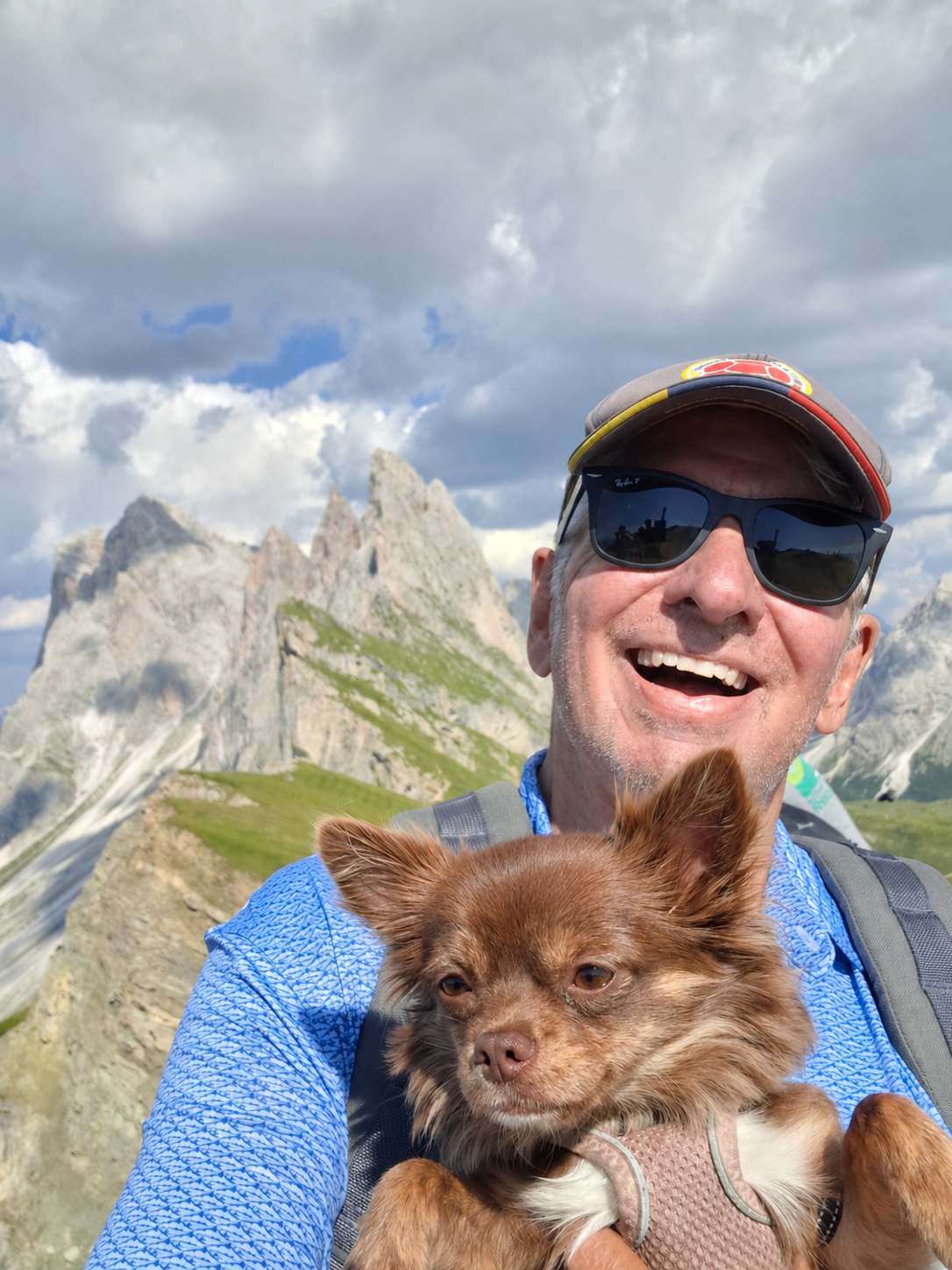
Then we ascended the mountain and were dropped off at …
THE SECEDA RIDGELINE!
The place we had come halfway around the world to see.
Just from the other direction.
“Osa, sometimes losing control is exactly how you get where you were trying to go!”
Who Takes Control?
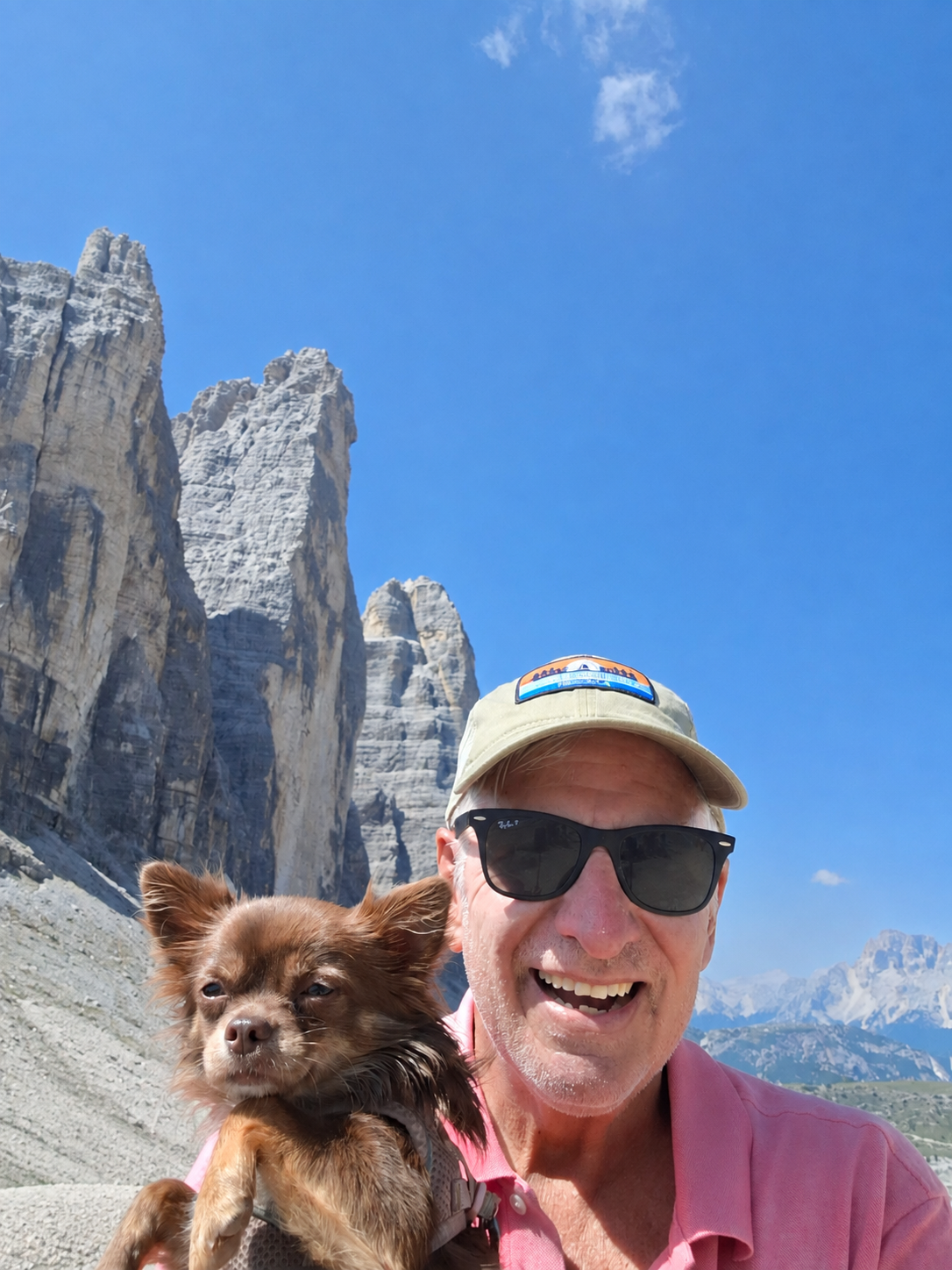
For the final leg of our journey, we bussed across the Dolomites’ massive expanse to what’s truly the “top of the top”: Tre Cime.
Seen one mountain, seen them all? Nope.
Seceda confronts you. Tre Cime surrounds you.
To reach the “three peaks,” you pass endless towers of silver stone and jagged peaks with coral hues rising from rolling green meadows. Looking down, we saw deep valleys with Alpine lakes that sparkled against a brilliant blue Dolomite sky.
As we grabbed a snack at the Auronzo Hut, in awe of the panorama opening around us, the spectacular scenery felt like the prize.
But not for little Osa. To her, the prize was the scents and feel of the trails.
They were every bit as tough as Seceda. Oddly, in quite a few segments, they were more Osa-friendly—gradual ascents and rugged, loose gravel she could really dig her paws into.
But for most of the circuit, she remained a passenger, confined to my backpack. There was no way her legs—four inches at the withers—could navigate the steeper parts of the trails.
It wasn’t easy, but we made it to “The Three Peaks.”
“Victory, Osita—Dog of the Dolomites!”
Mission complete, we retraced our tracks toward where we began. Exhausted but exhilarated: “We’re almost done, Osa. There’s Auronzo Hut.”
But Osa had been plotting the whole time. And the cue “Auronzo Hut” meant she was running out of time.
Suddenly, I felt her not just rustling but shaking behind me with increasing force—then my GR2 backpack became five pounds lighter.
Osa leapt out.
“Jesus Christ, Osita, you scared the shit out of me! Dangerous fucking move.”
She just turned her head confidently and smiled. “Thanks, Dad. I’ve got it from here. Damn, these trails feel good!”
And EARN THE TITLE, “OSA: DOG OF THE DOLOMITES!”
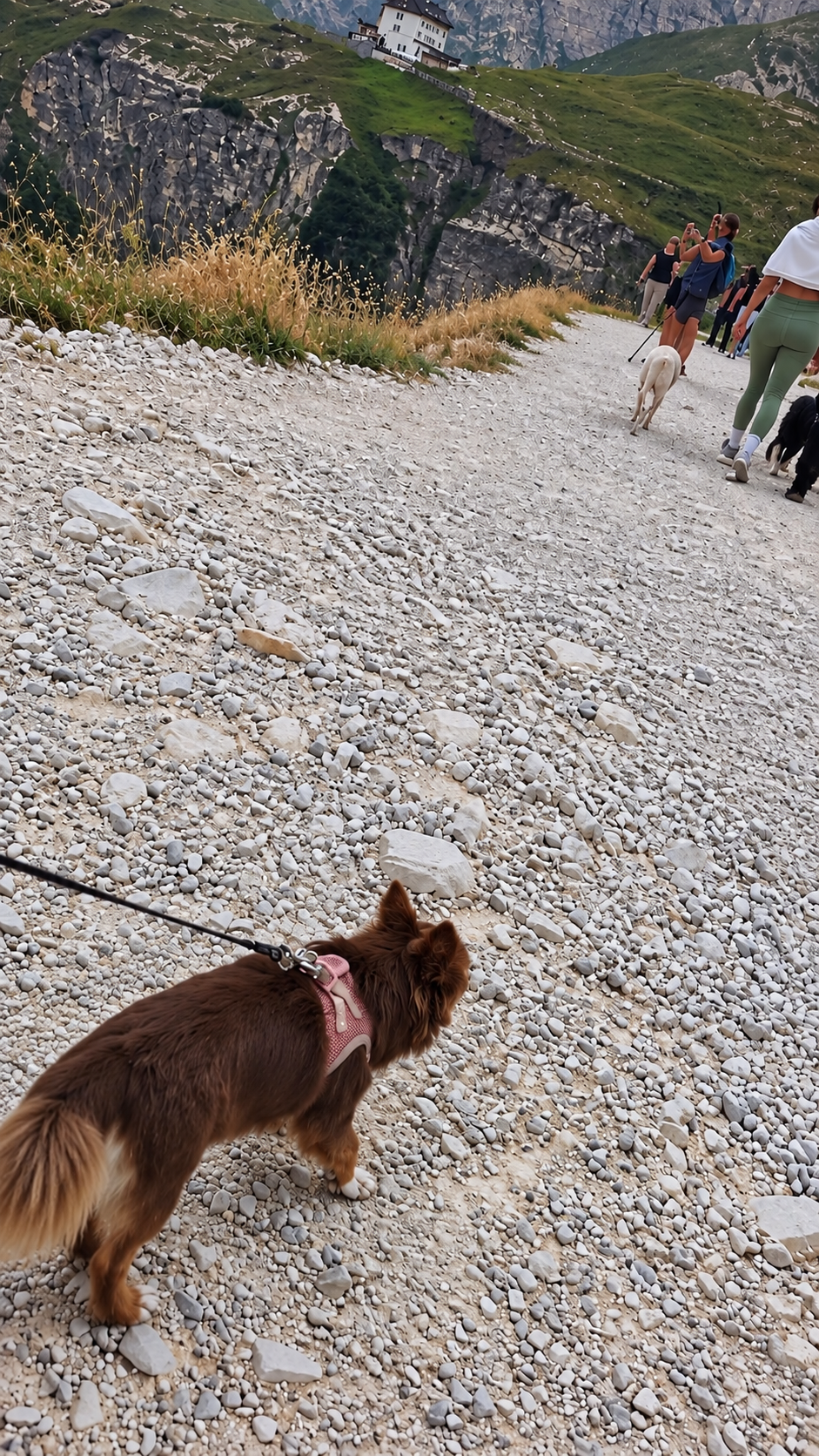
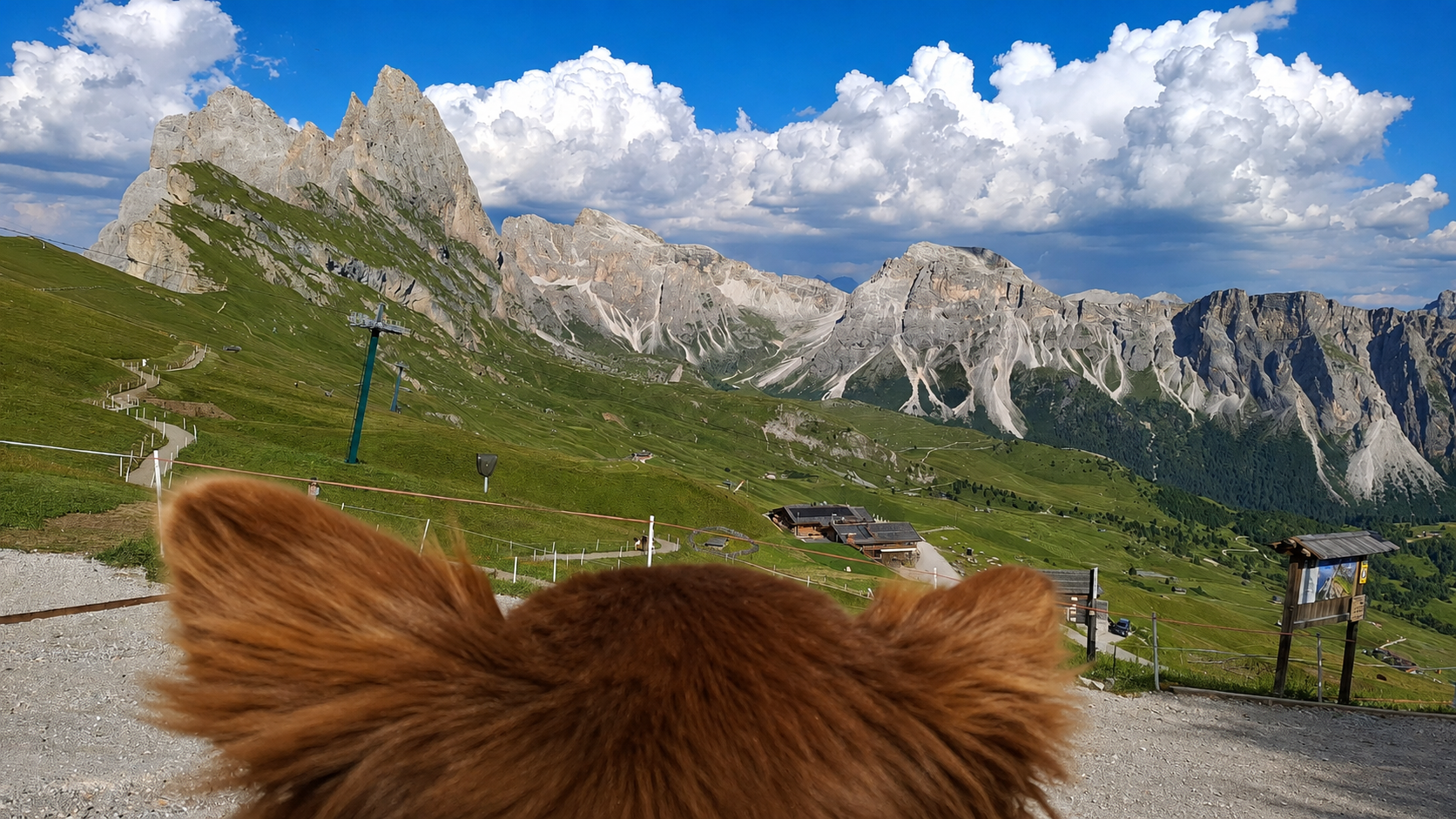
Now look again at the photograph at the top of this page!
Taken barely a minute before the jailbreak, it shows what I failed to see: Osa had already found her opening. The opportunity to commit the crime was hiding in plain sight. It only became obvious when I was reviewing the pictures on the bus back to our hotel.
For Osa to get her paws on that last rocky trail one more time, she …
NEEDED TO ACT
TAKE A RISK
GAIN CONTROL

The Victory Lap? THE VICTORY LAP!
As we packed our poles and boarded the last bus down our final Dolomite, I allowed myself one quiet thought:
We did it.
Then I turned to Osa.
“FUCKING A! WE DID IT!”
After everything the mountains had demanded—physical effort, patience, resolve, and every resource we had or could find—we had earned a victory lap.
Returning to Munich, getting ready to board our flight back to Chicago, Lufthansa had other ideas.
Forty-five minutes before departure, reluctantly anxious to return home, I heard the announcement:
“Mr. Corr, please come to the gate.”
Good God.
We’re fucked.
At the gate with our boarding pass in hand, Lufthansa had discovered that Chicago had a “dog embargo.”
In the old days, I would have screamed, argued, and scrambled for some impossible solution.
This time, I didn’t bother.
I accepted my fate and retreated with Osa to the Lufthansa lounge.
What had been bustling a few hours earlier now felt like an empty cave. The flights had departed. The remaining passengers were a collection of misfit toys.
Then, in a moment eerily like meeting Vanessa, a German man noticed my plight.
In that empty lounge, two strangers became present with each other. We shared our memories of nightmare travel stories in vivid detail. At first, we simply shook our heads.
Then we laughed!
And just as he was preparing to leave, the German turned to me and, in his heavy accent, said:
“My friend, in life we will make the best that is possible.”
Then he vanished.
I heard the words. I didn’t understand them.
Not yet.
Then I began turning over every word of that wonderfully imperfect sentence and applying it to our Dolomite adventure.
That was when I discovered what had been hiding in plain sight.
Make the best that is possible.
Turns out, that is what mattered the entire trip.
Whether it “worked out” or not, nothing was wasted. And that was when I knew our new process had been battle-tested.
PRESENCE helped us notice
MEMORIES helped us connect
DISCOVERING WHAT MATTERS gave us direction

So What ‘Mattered’ During Our Dolomites Trip?
Deftly Navigating the ‘Continuum of Control’
‘The Process’ we discovered …
Begin with a Make the Best That Is Possible mindset.
Realistically assess where you are.
Act when useful control remains—don’t be a passenger
Accept when no useful control remains
Risk when gaining control requires a leap
Adapt when circumstances shift
Just know, however it “works out”
The prize is that nothing was wasted.